Practical Life Activities for Montessori Families in {{City, State}}
Quick Answer
Summer is one of the best times to build on what your child is learning in their Montessori program — not with workbooks or scheduled lessons, but with real, everyday tasks. Practical life activities like helping prepare meals, caring for plants, or sorting laundry give children in [City], [State] meaningful ways to practice independence, focus, and confidence right at home.
Small Moments, Big Signals
You might notice these subtle shifts on a quiet morning. Your child reaches for the water pitcher before you do, or insists on pouring their own cereal even though the process takes a bit longer. Perhaps they ask to wipe the table after breakfast, or they stop to carefully arrange their shoes by the entry door. These unprompted moments reveal that your child is developing an inner drive for order, concentration, and autonomy.
The summer months offer the unhurried time required to let them explore these abilities.
You Don’t Need to Recreate the Classroom
When the school year wraps up and the slower days of summer begin, maintaining a consistent rhythm can feel challenging. However, you do not need to replicate the specialized layout of a physical classroom. The Montessori approach naturally complements home life; the most impactful, self-directed learning your child experiences this summer will likely unfold right within your kitchen, your garden, or your own backyard.
Why Practical Life Skills Are the Heart of Montessori Learning
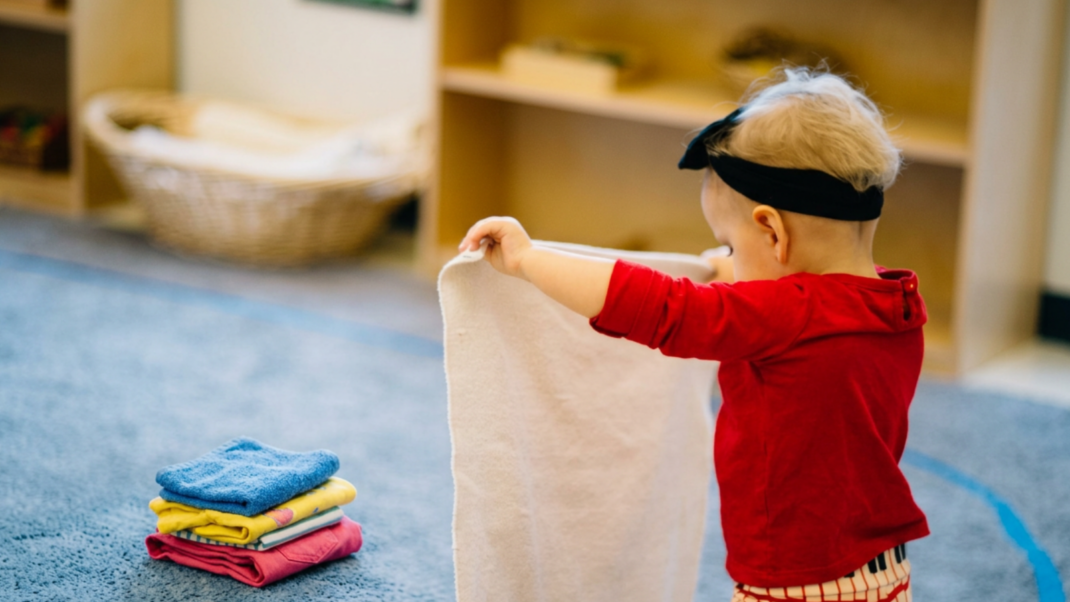
In a Montessori environment, practical life activities aren’t a warm-up to the “real” learning. They’re central to it. When your child folds a napkin, transfers water from one cup to another, or carefully carries a full plate to the table, they’re building the same concentration and hand-eye coordination that supports reading and writing later on.
The American Montessori Society describes practical life activities as one of the cornerstones of Montessori education at home — tasks that connect children to their environment, give them a genuine sense of contribution, and build the fine motor control and focus that carry into every other area of learning.
What makes these activities work isn’t the complexity. It’s that the task is real. Your child isn’t pretending to cook. They’re actually helping. That distinction matters more than most families realize.
Simple Summer Activities That Fit Naturally Into Your Day
You don’t need to plan a Montessori activity schedule. The best practical life moments come from including your child in what you’re already doing.
In the kitchen: Let your child wash fruits and vegetables before meals, tear lettuce for salads, or measure and pour dry ingredients for baking. A child who spends ten minutes carefully spooning batter into a muffin tin is practicing precision, patience, and sequencing — all in one task they’re genuinely proud to finish.
In the garden: Watering plants, pulling weeds, or planting seeds gives children a direct connection to care and responsibility. A child who waters the same tomato plant every morning for six weeks understands something about time and nurturing that no worksheet can teach.
Around the house: Sorting laundry by color, folding washcloths, sweeping a small area of floor, or setting the table are all activities a child between three and six can do with real independence when shown slowly and given the space to practice.
The key is slowing down the demonstration the first time. Show each step separately, without narrating too much. Then step back and let your child try.
How to Set Up Your Home So Independence Can Actually Happen
One reason practical life activities work so well in a Montessori classroom is that the prepared environment makes independence physically possible. Small pitchers, child-sized tools, and low shelves mean a child can act on their own initiative without needing an adult to intervene.
You can create the same conditions at home with a few small adjustments. Move one shelf or drawer in the kitchen to child height and stock it with their cup, a small pitcher for water, a bowl, and a snack they’re allowed to access on their own. Keep cleaning supplies — a small broom, a dustpan, a spray bottle with water — in a spot your child can reach. When the tools are available, the initiative follows.
This setup also removes one of the most common friction points of summer mornings: the negotiation over what your child can and can’t do. When the answer is built into the environment, both of you can move through the day with a lot less back-and-forth.
Following Your Child’s Lead This Summer
A trained Montessori guide spends the school year observing each child closely, noting which activities inspire deep concentration and identifying exactly when a new challenge should be introduced. You can carry this same practice of respectful observation into your home this summer.
Notice where your child’s interest naturally gravitates. If they are fascinated by water, invite them to rinse dishes or tend to garden beds. If they express a desire to join you while you prepare meals, dedicate a specific, safe step of the recipe exclusively to them. True ownership over a task fosters an organic focus that no forced activity can replicate.
You don’t need to get it perfectly right. The goal isn’t a flawless Montessori home setup — it’s a summer full of moments where your child gets to feel genuinely capable.
Frequently Asked Questions
What age is best for starting Montessori practical life activities at home?
Children as young as 18 months can begin simple practical life tasks — carrying objects, wiping surfaces, or transferring items with a spoon. The activities simply become more complex as children grow. By ages three to six, most children are ready for multi-step tasks like preparing a simple snack or caring for a plant independently.
How do I introduce a new practical life activity without it turning into frustration?
The most important step is a slow, silent demonstration. Show the task one step at a time without rushing, then invite your child to try. Resist the urge to correct or take over. If it doesn’t go perfectly, that’s part of the process — what looks like a mess is often just practice happening.
How is this different from just asking my child to do chores?
The spirit is different, even when the task looks the same. In the Montessori approach, a child isn’t completing a task because they were told to — they’re choosing it because it feels meaningful and they’ve been genuinely included. That sense of ownership is what builds intrinsic motivation rather than compliance.
Can these activities really support what my child is working on with their Guide?
Absolutely. Practical life activities at home reinforce the same concentration, coordination, and independence your child practices in the classroom. Many Guides encourage families to continue these routines over summer breaks specifically because they keep the child connected to purposeful, self-directed work.
A Summer Worth Saying Yes To
Summer doesn’t have to feel like a pause in your child’s growth. The slow mornings, the relaxed pace, and the extra time together are exactly the conditions where independence takes root. The tasks are already there — you’re just making room for your child to do them.
When you’re ready to see what this looks like day to day, we’d love to show you. Schedule a tour at [School Name] in [City], [State] and meet the Guides who make it happen.
Related Posts
All Posts
The Montessori Approach to Potty Learning: Tips for Families in {{City, State}}
Parent-Teacher Partnerships: Strengthening Early Learning in [City/State]